Fog Bow Seen at Blackmoor Golf Course – 14 January 2026
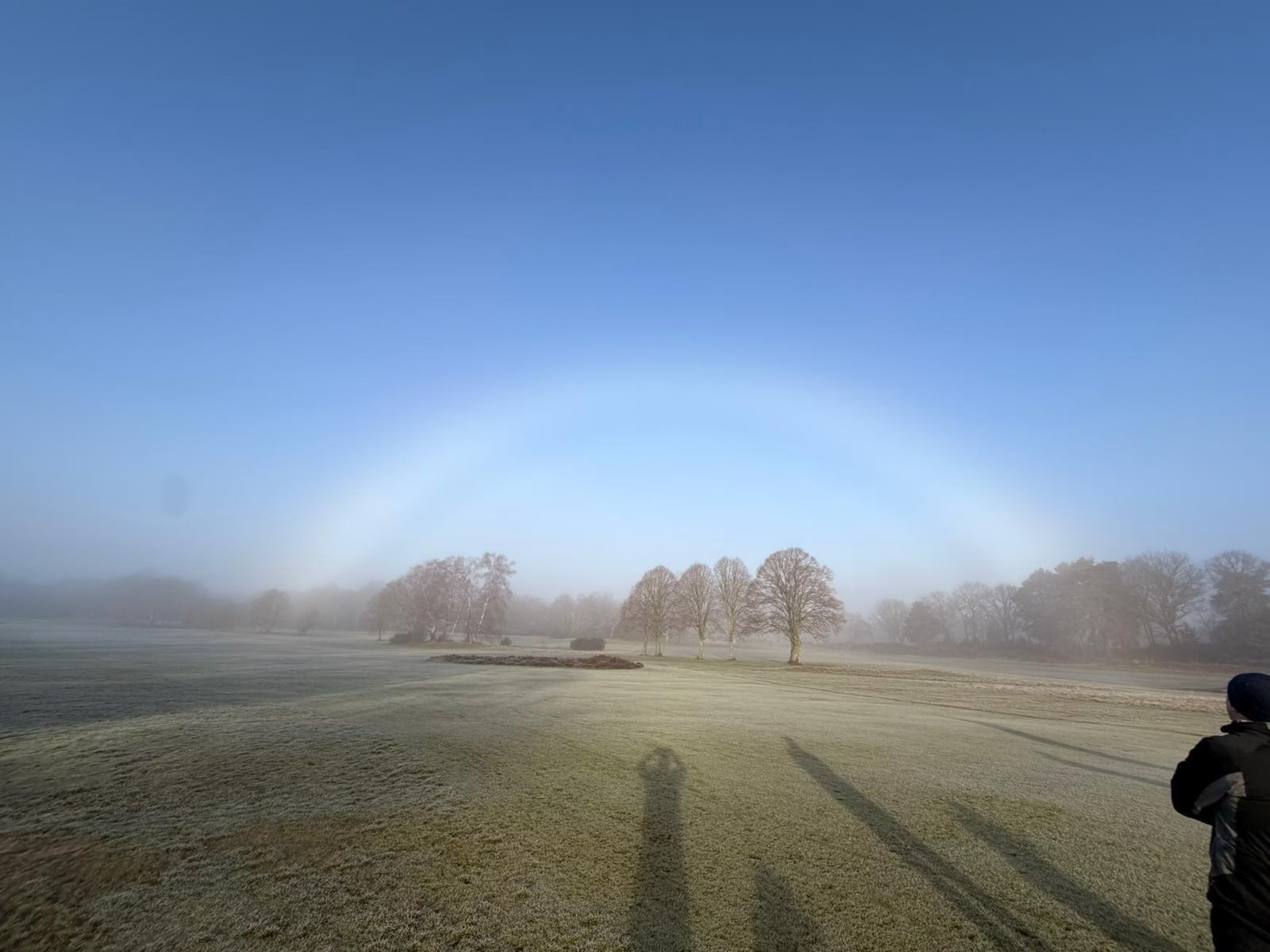
At 9:40 a.m. this morning, a clear example of a fog bow was observed and photographed on the 7th hole at Blackmoor Golf Course by my golfing colleagues. As the picture shows it appeared as a faint white arc opposite the low morning sun, within a shallow fog layer.
But what exactly causes a fog bow and how does it it differ from a standard rainbow?
What is a Fog Bow?
A fog bow is an optical phenomenon similar in geometry to a rainbow but differs in the physical processes that form it. It occurs when sunlight passes through tiny water droplets in fog or mist, rather than through larger raindrops. The droplets involved are usually smaller than 0.05 millimetres in diameter, far smaller than raindrops, which typically range from 0.5 to 2 millimetres.
These small droplet sizes significantly affect how sunlight interacts with them, producing a pale, almost white arc rather than the bright coloured bands of a rainbow.
How Fog Bows Form
When sunlight enters a water droplet, part of the light is refracted (bent) and reflected inside the droplet before leaving and reaching an observer. In a fog bow, because the droplets are so small, the effects of diffraction (the spreading of light waves) become dominant.
- In rainbows, refraction and reflection separate sunlight into distinct colours.
- In fog bows, diffraction causes the colours to overlap and merge, producing a white or faintly tinted arc.
The bow appears in the same general position as a rainbow – opposite the sun – at an angle of about 35 to 40 degrees from the antisolar point.
The appearance of a fog bow depends on the balance between sunlight intensity and fog density. If the fog is too thick, sunlight cannot penetrate far enough to form the bow; if it is too thin, the droplets may be too sparse to refract enough light. Optimal conditions tend to occur as fog is lifting, often in early morning or late afternoon.
Comparison: Fog Bows vs Rainbows
| Property | Fog Bow | Rainbow |
|---|---|---|
| Droplet size | < 0.05 mm (fog/mist droplets) | 0.5–2 mm (raindrops) |
| Dominant optical effect | Diffraction | Refraction and reflection |
| Appearance | White or faintly coloured arc | Bright, multicoloured bands |
| Definition | Broad and diffuse | Sharp and clearly defined |
| Weather type | Fog or mist | Rainfall and sunlight |
Why Fog Bows Appear White
The whiteness of a fog bow arises because the light waves of different colours are scattered and diffracted so strongly that they overlap completely. Each colour contributes to the overall result, but without enough separation to be perceived individually by the eye. The overlapping wavelengths combine to form light that appears white.
Occasionally, careful observation or camera enhancement may show very slight reddish and bluish edges, but to most observers the bow will appear as a plain white arc.
Meteorological Summary of Observed Event
- Date: 14 January 2026
- Time: 09:40 GMT
- Location: Blackmoor Golf Course (7th hole)
- Conditions: Lifting fog, visibility improving, solar elevation approximately 10–15° above horizon, temperature 3–5°C
- Phenomenon observed: White fog bow, complete lower arc visible, consistent with diffraction scattering
If you enjoyed reading this, the please explore our other articles below: